3 min read
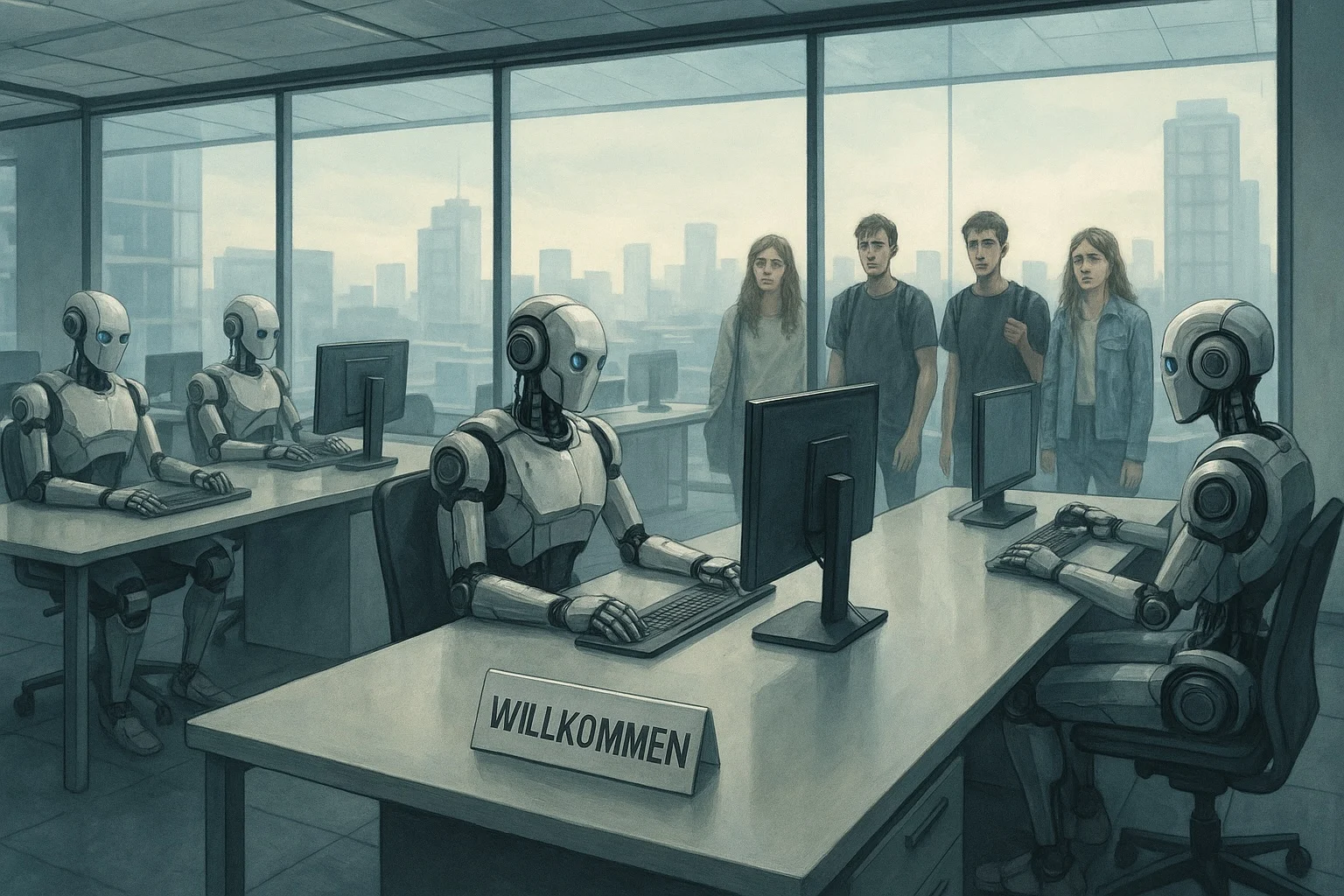
Times have rarely been more challenging for young talent in the labour market. While the skills shortage continues to grow in many industries, the number of advertised entry-level jobs is falling dramatically at the same time. According to Stepstone, the share of junior positions in the first quarter of 2025 collapsed by 45 per cent compared with the five-year average, a historic low.
The reason? Besides economic uncertainty, above all: artificial intelligence.
AI tools are increasingly taking over the classic tasks of career starters, whether in IT, consulting, marketing or law. Repetitive activities such as debugging code, research, creating presentations or market analyses can now be done automatically in minutes.
What creates efficiency in the short term threatens to destroy know-how in the long term. Without a way in, there is no development, and without development, there are no experts of tomorrow.
Why the loss of entry-level positions is a risk for companies
The decline in junior roles caused by AI has far-reaching consequences:
- Know-how building stalls
Without operational entry-level tasks, career starters lack practical experience. They cannot develop systematically.
- The skills shortage worsens in the long term
AI can replace many tasks, but not all. Leadership, communication, creativity, customer understanding and strategic decisions require experience. Anyone who does not invest in talent today will have no experts tomorrow.
- Knowledge gaps and age-structure problems
Companies with ageing workforces risk losing experiential knowledge in an unstructured way, especially in times of demographic change.
- Damage to employer image
A company culture without support for the next generation appears backward-looking and puts young talent off.
What companies can do now: 5 solutions to the AI talent-pipeline dilemma
1. Create new learning roles
Instead of simply scrapping traditional junior positions, companies should create new roles with an AI-supported learning curve: "AI-assisted junior positions", in which career starters work with AI tools but take on real responsibility under supervision.
2. Systematise knowledge transfer
To make sure know-how is not anchored only in seniors, tools and processes for knowledge transfer are needed: wikis, internal learning platforms, reverse mentoring, or even "digital twins" (digital documentation of decisions and methods).
3. Shift the mindset from efficiency to effectiveness
The disappearance of repetitive tasks should not just lead to savings, but to freeing up resources for development and innovation.
4. Strengthen partnerships with universities
Through early cooperation with educational institutions, companies can introduce young talent to practice, technology and company culture, for example through working student positions, practical projects or guest lectures.
5. Align employer branding with the next generation
Companies that show clearly how young talent still finds a place despite AI position themselves attractively in the competition for bright minds: "With us, AI does not replace talent; it supports it."
Conclusion: AI replaces tasks, not development
AI is a game changer, particularly at junior level. But companies that turn it into nothing more than a short-term efficiency strategy are, in the long run, sawing off the branch they are sitting on. The challenge is to rethink entry-level roles, not to scrap them without replacement.
Companies that invest now in future-proof ways of getting started are not only building bridges for the next generation, but also safeguarding their own capacity for innovation and competitiveness.
Sources:
Stepstone: https://www.stepstone.de/e-recruiting/hr-wissen/arbeitsmarkt/recruiting-trends/