5 min read
EQ and IQ: Why leaders need both to be successful
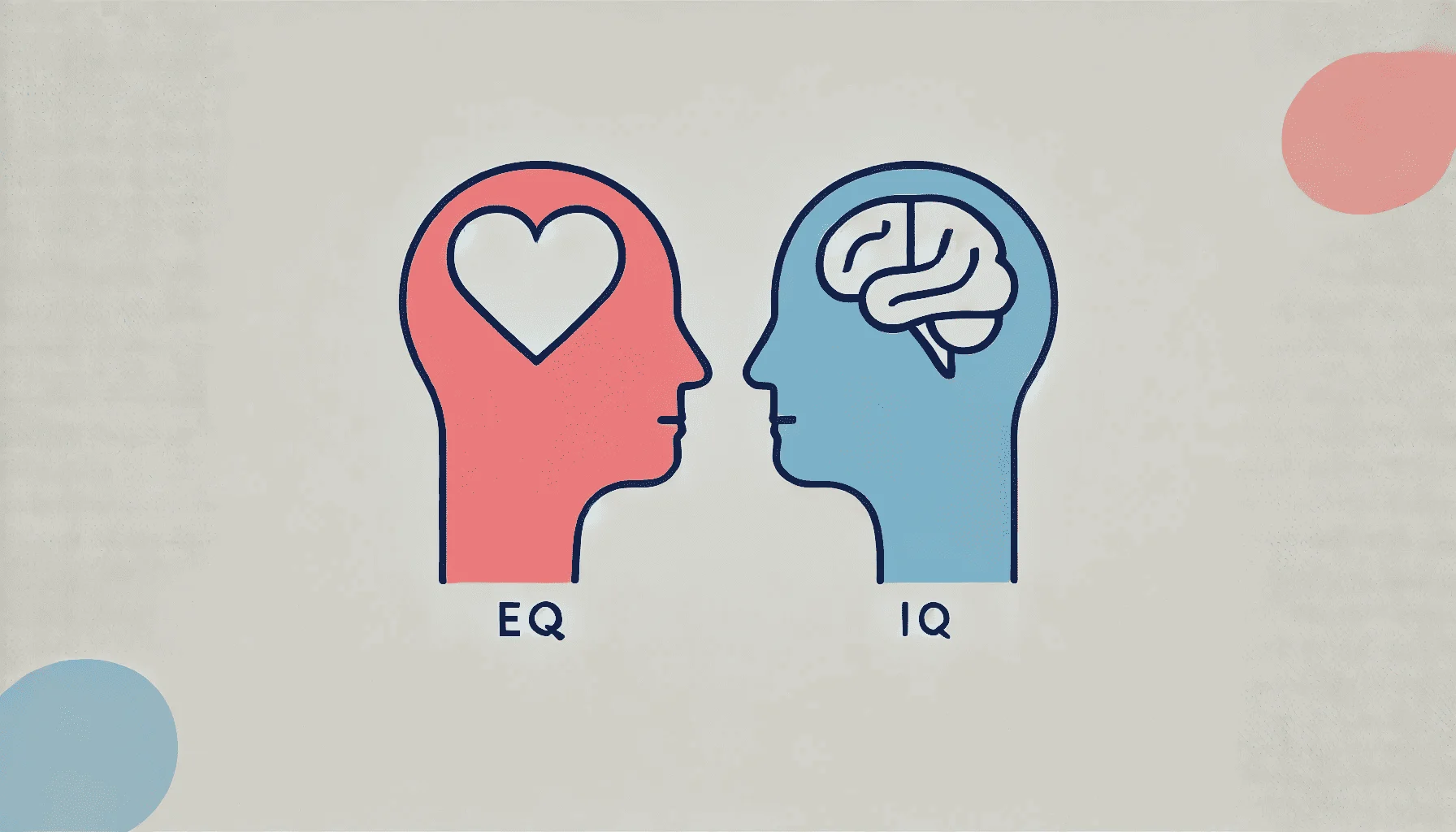
In the modern world of work, there is frequent discussion about what distinguishes leadership and what an ideal leadership style should look like. Two terms come up again and again: IQ (intelligence quotient) and EQ (emotional intelligence). While IQ is often regarded as a measure of cognitive abilities such as problem-solving and analytical skills, EQ plays a central role in dealing with people and understanding interpersonal relationships. But which carries more weight in leadership?
The balance between EQ and IQ
Successful leadership depends on a combination of both. IQ forms the basis for strategic thinking, analytical decisions and the ability to solve complex problems. EQ, on the other hand, makes it possible to combine these abilities with empathy and social competence. Particularly in times of change, whether driven by digitalisation or a global crisis, a leadership style is needed that not only understands facts but also reads emotional signals and responds to them.
EQ as the key to successful leadership and employee retention
The concept of emotional intelligence was popularised in the 1990s by the psychologist Daniel Goleman and has become ever more relevant to the world of work since then. Studies show that teams led by managers with a high EQ are not only more productive but also more satisfied. Managers with a strongly developed EQ are better able to recognise when a team member needs support and tend to spot tensions in the team early. In industries under heavy pressure to innovate, such as life sciences, pharma or medical technology, where complex projects and interdisciplinary collaboration are everyday business, this competence is particularly in demand. A well-developed EQ strengthens the corporate culture and makes a significant contribution to employee retention.
IQ for strategic challenges in leadership
At the same time, IQ must not be underestimated. Leaders in technology-driven industries must be able to make data-based decisions, analyse trends and develop innovative strategies. IQ helps them keep an overview of complex business processes and make well-founded decisions. Successful leadership combines these analytical abilities with emotional sensitivity
Interim conclusion
While IQ was often regarded in earlier decades as the sole foundation of success for leaders, the understanding of leadership has changed in recent years. Today, employees expect more than instructions. They are looking for trust, inspiration and respectful treatment (Generational diversity in the workplace). This does not mean that IQ is less important, but that it must be complemented by EQ to ensure effective leadership.
EQ, IQ and more: the importance of SQ and CQ for modern leadership
In an increasingly globalised and interconnected world, spiritual intelligence (SQ) and cultural intelligence (CQ) are also becoming more relevant to leadership. In contrast to EQ, which focuses on the ability to perceive and understand one's own and other people's emotions and to respond accordingly, SQ describes the ability to integrate meaning, values and ethical principles into one's own actions and to make decisions in harmony with a larger whole. This can prove particularly effective when leading teams in which different personalities and perspectives come together.
CQ, in turn, enables leaders to deal successfully with cultural differences, a key competence in international leadership. CQ helps to avoid misunderstandings and to foster an inclusive corporate culture. Together with EQ and IQ, SQ and CQ form the foundation for holistic leadership that is aligned with the demands of the modern world of work.
How to strengthen your EQ:
- Active listening: Deliberately take the time to understand your employees.
- Accepting feedback: Reflect on your own impact and ask for feedback regularly.
- Showing empathy: Try to understand the perspectives of your colleagues and employees.
- Regulating emotions: Learn to keep a cool head in stressful situations.
How to strengthen your SQ:
- Regularly reflect on your values and goals – Deliberately take time for self-reflection to question the purpose of your work and to foster your personal development.
- Practise mindfulness in everyday life – Use techniques such as meditation or breathing exercises to find inner calm and make clearer, more conscious decisions.
- Connect your actions with a larger purpose – Focus on the positive impact of your work on those around you and inspire others through a sense of meaning.
- Act on ethical principles – Make decisions in line with fairness, sustainability and justice, and be a role model for your employees.
Conclusion: the perfect combination for modern leadership
Good leaders combine strong analytical abilities with emotional sensitivity, social competence and cultural understanding. EQ, IQ, SQ and CQ are not in competition; they complement one another. Only those who practise leadership with a clear mind, heart, social sensitivity and cultural openness succeed in motivating and leading teams successfully in the long term.
Sources:
Akhter, A. (2021). The impact of emotional intelligence, employee empowerment and cultural intelligence on commercial bank employees’ job satisfaction. Banks and Bank Systems, 16(4), 11-21.
Fareed, M. Z., Su, Q., & Awan, A. A. (2021). The effect of emotional intelligence, intellectual intelligence and transformational leadership on project success; an empirical study of public projects of Pakistan. Project Leadership and Society, 2, 100036.
Goleman, D. (2021). Leadership: The power of emotional intelligence. More Than Sound LLC.
Hacker, S. K., & Washington, M. (2017). Spiritual intelligence: going beyond IQ and EQ to develop resilient leaders. Global Business and Organizational Excellence, 36(3), 21-28.
Kim, H. T. (2020). Linking managers’ emotional intelligence, cognitive ability and firm performance: Insights from Vietnamese firms. Cogent Business & Management, 7(1), 1829272.
Momeni, N. (2009). The relation between managers' emotional intelligence and the organizational climate they create. Public personnel management, 38(2), 35-48.
Rockstuhl, T., Seiler, S., Ang, S., Van Dyne, L., & Annen, H. (2011). Beyond general intelligence (IQ) and emotional intelligence (EQ): The role of cultural intelligence (CQ) on cross‐border leadership effectiveness in a globalized world. Journal of Social Issues, 67(4), 825-840.
Sherry, M. (2016). EQ is More Important than IQ. International Journal of Engineering, Management, Humanities and Social Sciences Paradigms (IJEMHS), 24(01).
Shek, D. T., & Lin, L. (2015). Intrapersonal competencies and service leadership. International Journal on Disability and Human Development, 14(3), 255-263.
VanderPal, G. (2014). Global leadership, IQ and global quotient. VanderPal, G.(2014). Global leadership, IQ and g lobal quotient. Journal of Management Policy and Practice, 15(5), 120-134.